I spent five days last week in the Blue Hills of northern Wisconsin, helping a gaggle of about 90 volunteers build new trail for the Ice Age Trail Alliance so they can re-route the IAT through a more scenic part of the county. It’s a beautiful part of the state that I don’t visit often enough; I’ll have to go back in a couple weeks to have a wander on my own.
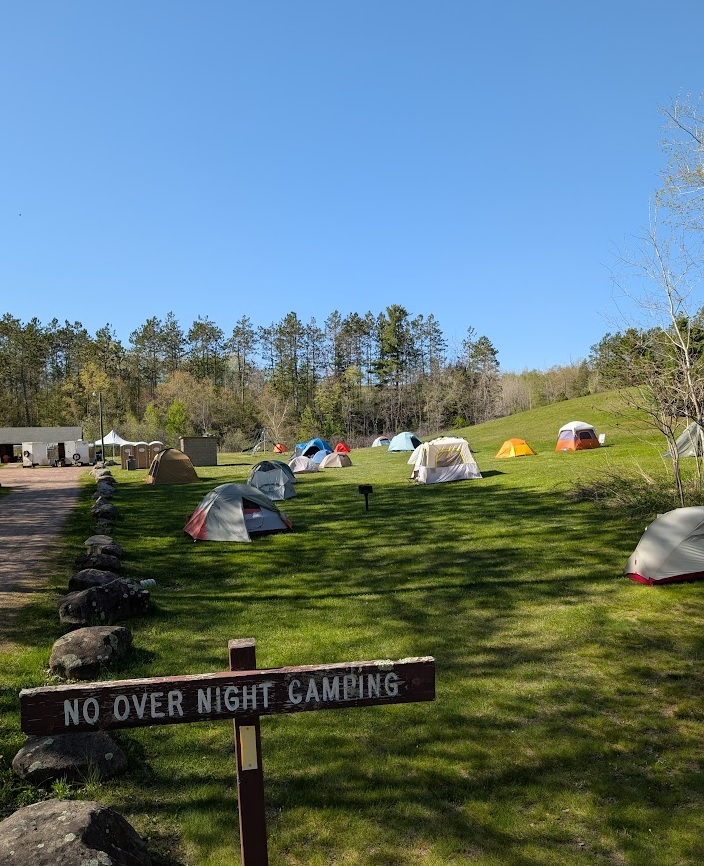
We were allowed to camp in the Murphy Flowage County Park while we worked on the trail. It’s not normally a campground, but for a few nights the lawn was festooned with pop-up tents of all sizes. I found a cozy spot at the edge of the park where I could hang my hammock between a couple trees in the lee of a hill.
These trail-building events are pretty big operations run impressively well by Alliance staff. Volunteers provide all the labor for cutting the trail, while the Ice Age Trail Alliance provides a place to camp, breakfast and dinner every day, two big trailers filled with hand tools, and the management needed to make it all work. Members from the Blue Hills Chapter of the IATA are on hand to help the rest of us, but I’m always amazed to find out how many people from all over the state come to these events. I was not the only person who drove four hours or more to help out.
I moved rocks the first two days of the event. I was on a team of four people who placed stepping stones in muddy drains so hikers wouldn’t turn those drains into mud wallows. Calling them “stepping stones” makes them sound like smallish, easily-moved rocks, but no. We were using six-foot-long steel pry bars to dig up 400-pound rocks and roll them into nets. Each of us grabbed a corner of the net to carry the rock out of the woods to the trail, and it was not easy! We set four rocks on the first day, three on the second day. The first day was harder because of the uneven, mushy ground we had to work on. The ground around the two other sites we worked on was wet but firm, so digging and setting the stones went much faster. But after a day rocks around, I went to bed exhausted.
We finished setting rocks early on the second day, so we moved down the road to cut a new section of trail. I spent the rest of the day raking leaf litter and twigs, then grubbing little seedlings out of the ground. You know how you see a gojillion little tree seedlings popping up out of the ground when you go walking through the woods? To cut a new trail through a forest, all those little seedlings have to be pulled up by hand. That was me. I was doing that.
The second two days of the event were the two hottest days, and we spent them deep in the woods, raking and scraping and swinging a pick-mattock to grub stumps out of the ground. We left the biggest stumps for a specially-designated crew who came through with a winch to pull them up. Anything small, say the thickness of my thumb or smaller, was my job. A pick-mattock makes pretty short work of them, but there are usually a lot, so it’s hot, sweaty work. I drank a gallon of clear water each day, and I’m pretty sure I sweat every drop of it back out before I went back to camp at the end of the day.
The final day was reserved for pulling all the tools out of the trailer, knocking the dirt off them, and oiling them so they wouldn’t rust. The forecast called for rain so we started early, finishing up by eight-thirty. I left just as the rain began to spit down.


Leave a Reply