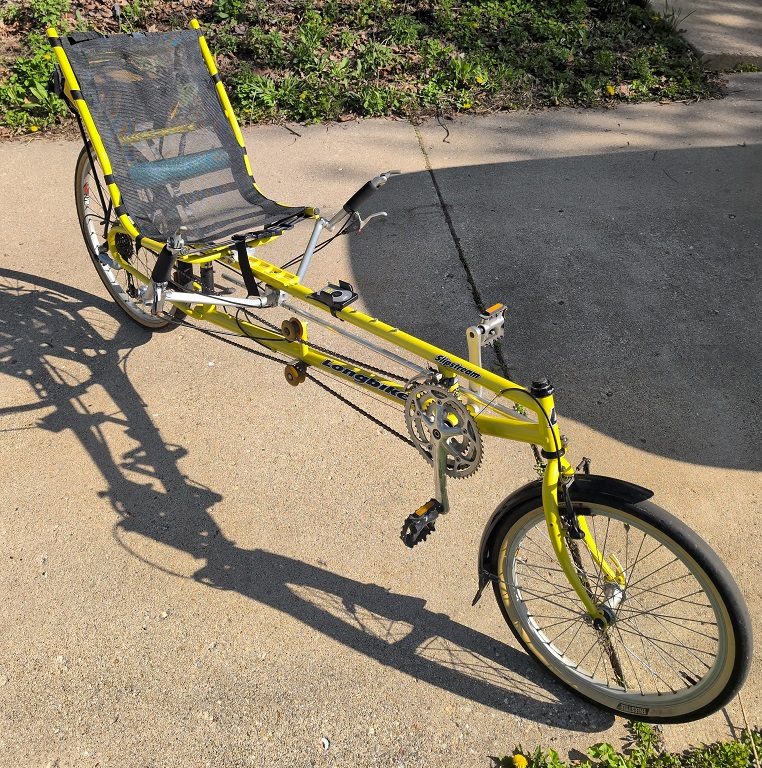
I finally bought a recumbent bicycle. I’ve wanted one for years but the price always scared me away. Used recumbents cost more than a thousand dollars; new recumbents cost more than two thousand. It was hard enough to make myself spend more than three hundred on a nice Trek bicycle back in 1998.
But Monday afternoon, while I was looking for something else, I noticed a used recumbent bike for sale on Facebook for just $400 — still a lot of money, but in the world of recumbents the seller was practically giving it away.
At first I hesitated to respond. The bike maker was Longbikes, and the model name was Slipstream. I found the maker’s web site, where they were still selling new bikes. A new Slipstream sells for more than three thousand dollars, and used ones were typically selling for more than two thousand, which made me a bit leery of paying just four hundred. Seemed like a red flag.
Then I remembered I bought my Trek street bike for just seventy bucks at a yard sale in my neighborhood from a guy who was moving to California and just wanted to get rid of everything, so he sold it at a loss. This was most likely the same situation, I figured, and decided to take the chance. I could always make an excuse and walk away if the sale seemed sketchy.
The seller was Sheila, a woman a little older than me. She and her husband Mike were avid cyclists and both owned two-wheeled recumbents but after twenty years of riding had moved up to recumbent trikes and wanted to declutter their garage. Mike said they listed their bikes last season at a higher price but got no takers. That’s why they offered to sell at a bargain-basement price this time around.
I asked if I could take it for a test drive. Mike said sure, gave me a few tips and a push, and sent me on my way down the street. What a humbling experience that was. It was like being eight years old again, learning to ride a bike for the first time. Fun, exhilarating, but fraught with peril as the bike threatened to dump me on the asphalt every other second. I was constantly hunting from side to side, trying to find my balance. I tended to overcorrect with steering and couldn’t figure out which way to lean, which was very hard to do from a reclining position.
“It’s going to take a little practice to get used to,” Mike warned me, peppering me with more tips to keep it going. It was genuinely helpful, but it was a lot at once. Without his advice, though, I almost certainly would have crashed it right out of the gate.
After I got it home, I really wanted to take it for a ride but I was supposed to make dinner, so I left it in the van, thinking I would get it out tomorrow. When I got inside, though, Barb said she wasn’t ready to eat and thought when she was, she wouldn’t want more than toast with peanut butter. “Go. Take your new bike for a spin,” she said.
She came out to get a look at it and watched me ride away. I didn’t go far, and not more than a couple blocks from home, in case I fell and had to limp back. I did fall once, but didn’t hurt myself. My butt was less than twelve inches off the ground so I didn’t have far to fall. Still hurt, though.
I spent almost all Tuesday morning and part of the afternoon learning to ride a bike again. I found out on my short ride the day before that the three things I had the most trouble doing were starting from a dead stop, turning either direction, and not falling over. Before I went anywhere on my new bike, I would have to learn do do at least the first two things.
So I rode up a nearby street where the pavement was perfectly flat and there was practically no traffic at all, and I started making wide turns across the road. For about an hour, that’s all I did: big, slow, wide turns, first one way, then another. Fell over a couple times. Checked for blood or broken bones, got back on the bike when I found neither, and started again.
Two things I learned right away: The first is, it’s a lot easier to fall off a recumbent than it is when riding a regular upright bike. I think this is because when you get into trouble on a regular bike, you hit the brakes and put out your feet and Shazam! You’re standing up! But on a recumbent, you’re nearly already on the ground, so when you hit the brakes and put your feet down, your legs don’t have a lot of leverage to hold you upright. Or at least, mine don’t. While I practiced turning, I fell over at least three times, probably more — I stopped keeping track.
The second thing I learned was, I had to lean away from the turn. I did this without thinking on a regular bike. On a recumbent, I had to make myself think about it. Sitting back with my shoulders pressed into the back of a seat, I tended to lean over with the bike as it turned, and that’s why I ended up on the pavement so many times.
After riding up and down and round and round the streets within eyeshot of my home all morning, I started to feel like I might be getting the hang of it, so I took a ride a little further down the road past the library to the other end of town. The streets of Monona are almost entirely residential, so I didn’t have to worry too much about traffic. I had most of the streets all to myself. I got a little more practice turning corners at speed, climbing hills, and not falling over, not even once.
Four or five hours of that was enough for one day. I showered off the sweat and the little bits of asphalt and gravel still stuck to me after all the falling, then stretched out on a lawn chair and rested my eyes for a well-deserved nap.


Leave a Reply