I’ve hiked many trails where stepping stones had been arranged to cross a small stream or a shallow river and when I did, I wondered how much effort and ingenuity it took to move those big stones into place. This week I found out.
The Ice Age Trail Alliance was cutting a new trail through land managed by the Cedar Lakes Conservation Foundation. I live relatively nearby, only a 90-minute drive, so I volunteered to help for two days, fully expecting to spend both days grubbing rocks and roots out of the dirt, lopping branches off trees and saplings at the root, and “cutting tread,” the technical term for digging a trail through the dirt in a way that is sustainable over a long period.
I drove up Thursday morning, getting up early enough to arrive in time for the eight o’clock round-up where they call out the daily assignments, and was happily surprised to find out I would be on the stone crew. I’d heard about their work when I helped out at the Straight River project and it sounded like something I wanted to get involved in. We carpooled out to the trailhead, then hiked out to the work site about halfway along the segment of trail the volunteers were cutting through the forest. The sawyers hadn’t been through that neck of the woods yet, so we had to hike over or around a few fallen trees that were waiting to get chopped up.
I just want to comment here how surreal it is to bushwhack through the woods in the first days of a project like this, knowing I’m among the first people to hike this segment of the Ice Age Trail. Nobody else will get the chance to see the woods like this, nobody else will know the trail before it was a trail. And when I walked out of the woods on Friday afternoon, there it was,a fresh new segment of the Ice Age Trail stretched out before me, almost like it had always been there.
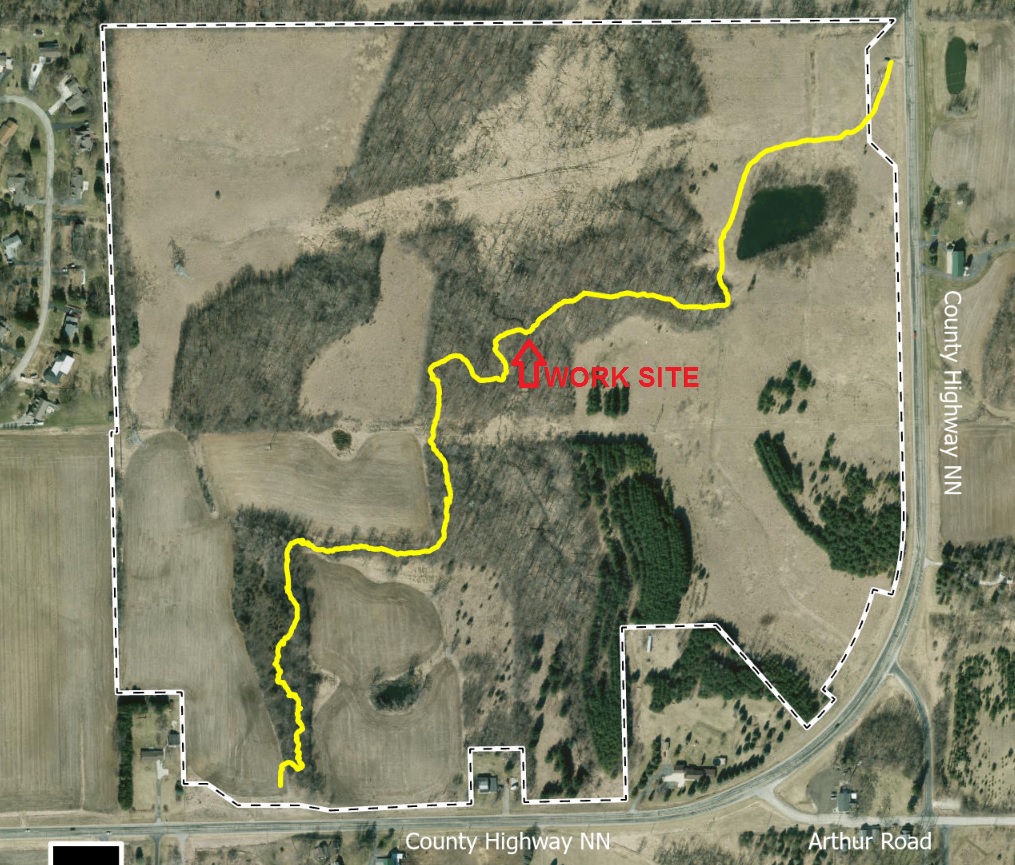
The work site was a dry river bed where there’s a lot of water moving downstream in the spring and during heavy rainfall. Our job was to arrange stepping stones across the channel so hikers could cross the stream when it was running. They had to be relatively large stones so a flash flood wouldn’t wash them away. We selected stones from a couple piles at the top of the hill where farmers had piled them up over the years after picking them out of their fields.
Wendell, our team leader, selected several stones he wanted to move down the hill to the river bed. These were big stones. Heavy emphasis on big. If I had ever looked at those stones all by myself, my first and only thought about them would have been, “Those stones aren’t going anywhere until a glacier comes along to move them.” But we had seven people on our crew, five long steel bars, and a reinforced dolly nicknamed “The Brute,” and over the next two days we rolled those stones down the hill, into the river bed, arranged in a line and adjusted until they were at the correct height, level, and bedded solidly into place. And I don’t mean to brag, but I feel we did one heck of a job.


(“That seems like a statistically significant number of Daves,” my daughter-in-law commented, after she saw this photo. Weirdly, this wasn’t all the Daves who showed up; there were at least two more.)


 This Is Drivel
Leave a comment