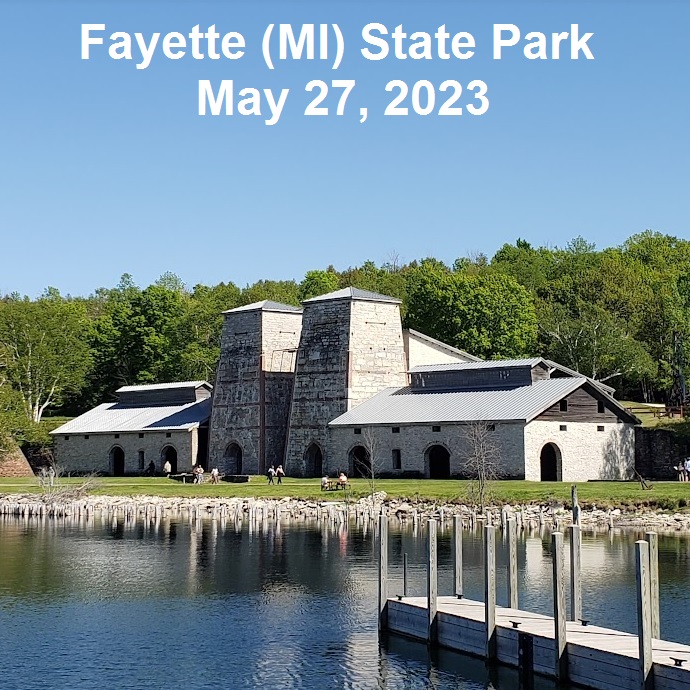
I woke up a little before six on Saturday morning, way before anyone in the campground was up and about. They all stayed up late the night before, gathered around the massive bonfires they built up in nearly every camp site. These were the quietest bunch of campers I’ve been around yet. I’ve been to plenty of state parks where they kept the music cranked up half the night or whooped and hollered all night long, but here they kept the music at a reasonable level and had a nice quiet chat around the campfires. It was a nice change.
After a breakfast of a big bowl of hot instant oatmeal chased with a mug of coffee, I hiked into town to have another look around. Or rather, I hiked through the town up to the trailhead at the end of the limestone cliffs that overlook the town. I wanted to see if there were any scenic overlooks from the edge of the cliffs. Oh yeah. There were a few.
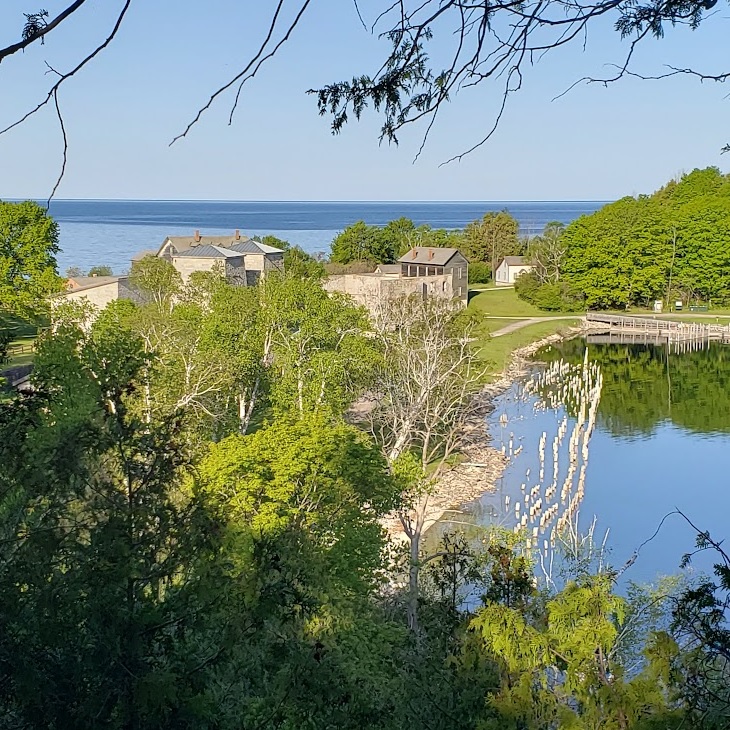
The first overlook was almost right above the town but the trees boxed the view in pretty tight. There wasn’t a great view of the buildings but it gave me a pretty good idea how far out into the harbor the wharf reached.

The second overlook had possibly the best view of the town and a very cool sign with a photo taken from the same spot of the town after the furnace operation had been shut down but while the town was still a tourist destination.


The view from the third overlook was again boxed in by trees but still gave me a good look at the buildings in the center of town.

The view from the fourth and final overlook was a little over half a mile from town, just outside Snail Shell Harbor. Mostly all I could see of the town from here was the hilly spit of land where the middle-class neighborhood was built. Only the supervisor’s house and a couple single-family houses were visible on the near side of the spit. The furnace is just barely visible behind the trees at left. The hotel is the tallest building in the center of town.
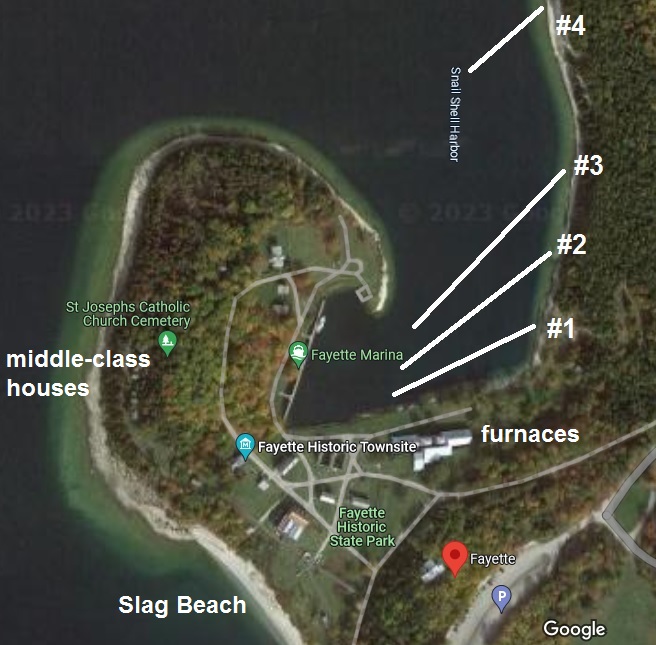
The middle class residents of Fayette lived in small wooden-frame houses on the west side of the spit, as far from the furnace complex as possible, with a tree-covered hill between them. Weirdly, the most high-class house in town, the supervisor’s, was on the near side of the hill overlooking the harbor, I guess so he could have a clear view of the furnaces? Doesn’t seem like a prime spot to me.
The lowest-class citizens lived in “huts” along the shore on the south side of town where the slag from the furnaces was dumped. This shoreline became known as, what else, “Slag Beach.”

When you visit Slag Beach today you’ll find that it’s an attractive, even scenic spot. A bench has been helpfully installed at the edge of the grass so you can gaze out over the water. Most of the slag has been washed away over the years, leaving behind a pretty white beach of limestone scattered with driftwood. Almost nobody notices the black slag gravel pouring out of the paths cut through the grass by visitors.

Iron ore has lots of impurities in it. You have to boil them off if you want to use the iron to make anything. You need lots of hardwood to get the ore hot enough and you need limestone for the chemical reaction that separates the impurities. Hence the furnaces at Fayette.
Slag is what they called the waste product that’s made when they boiled off the impurities. I don’t know if it’s toxic but living on top of a big pile of it probably isn’t great for your health. It has sharp edges when it breaks apart, it’s shot through with rusty iron and probably tetanus, and it’s kind of ugly. Small wonder the poor people got to live in huts on the slag heap.
The middle-class neighborhood, by contrast, was nestled in the woods along the shoreline. There were single-family and duplex frame houses on limestone foundations, clad in what appeared to be cedar clapboard and roofed with cedar shakes. I was fascinated by these houses as a kid and they’re still pretty fascinating.

If I understood correctly, some of these houses were saved from ruin because some residents stayed put after the furnace operations shut down. Houses that were abandoned were bought up by the same company that bought the hotel, then rented to tourists.
About a half-dozen have been restored and are open for the public to go inside and look around. Maybe another half-dozen are still standing but have been pretty savagely ravaged by the elements over the years. These are the houses that fascinate me most, I guess because I can’t get into them.

I could peek inside some of the houses that are closed up but it was so hard to see anything. The glass was really dirty and the bright sunshine made for a lot of glare. While I was trying to take a photo of one interior, though, I learned that if I pressed my phone against the glass, the body of the phone blocked the glare and the camera could focus past the dirty glass. Once I got the knack of this, I got a good look at the interiors of quite a few of the closed houses!
Most of the interiors are badly damaged by water or, in the house shown above, by varmints stashing their winter stores in the ceiling. It looks to me like the nuts, or whatever that is spread out on the floor, got soaked with water leaking in through the roof, which speeded up the rot of the plaster and lath until it broke through and spilled onto the floor. Looks to me like the floorboards are nearly rotted out too. And check out how steep that stairway is!

Another house was being used to store a wide variety of found objects, spread out on the floor for easy identification, not that I can tell what most of them are. I can see a dust pan and what looks like half of a pair of ice tongs, but most of it looks like scrap iron to me.
There’s an impressively tall stack of cedar shakes behind the table in the next room, which indicates to me that the floor of this house has not only avoided rot but it’s still strong enough to bear quite a lot of weight.
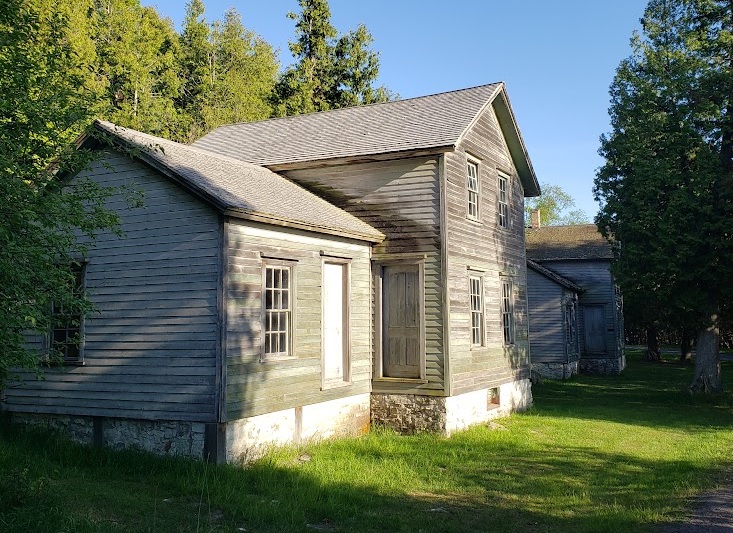
Here’s what both the varmint nut house and the rusty stuff house look like from the outside. They’re really quite roomy little houses. I imagine you’d have to be pretty high up the company food chain to land your family in one of these.
After hiking along the cliff’s edge, then wandering back and forth through the town to explore the houses, it was getting close to the lunch hour and I was getting hungry. Also, the town was getting crowded with tourists, so I hoofed back to the campground to pile up some lunch meat and cheese on two slices of thick nutty bread and make like Dagwood. After filling my belly, I stretched out in the sun for an afternoon nap to recharge my batteries before doing any more exploring.

I went back into town in the late afternoon to have a little wander but I was getting tired so I didn’t stay too long. I did have a pretty long look at the company store, which is the roofless stone building between the furnace complex and the hotel.
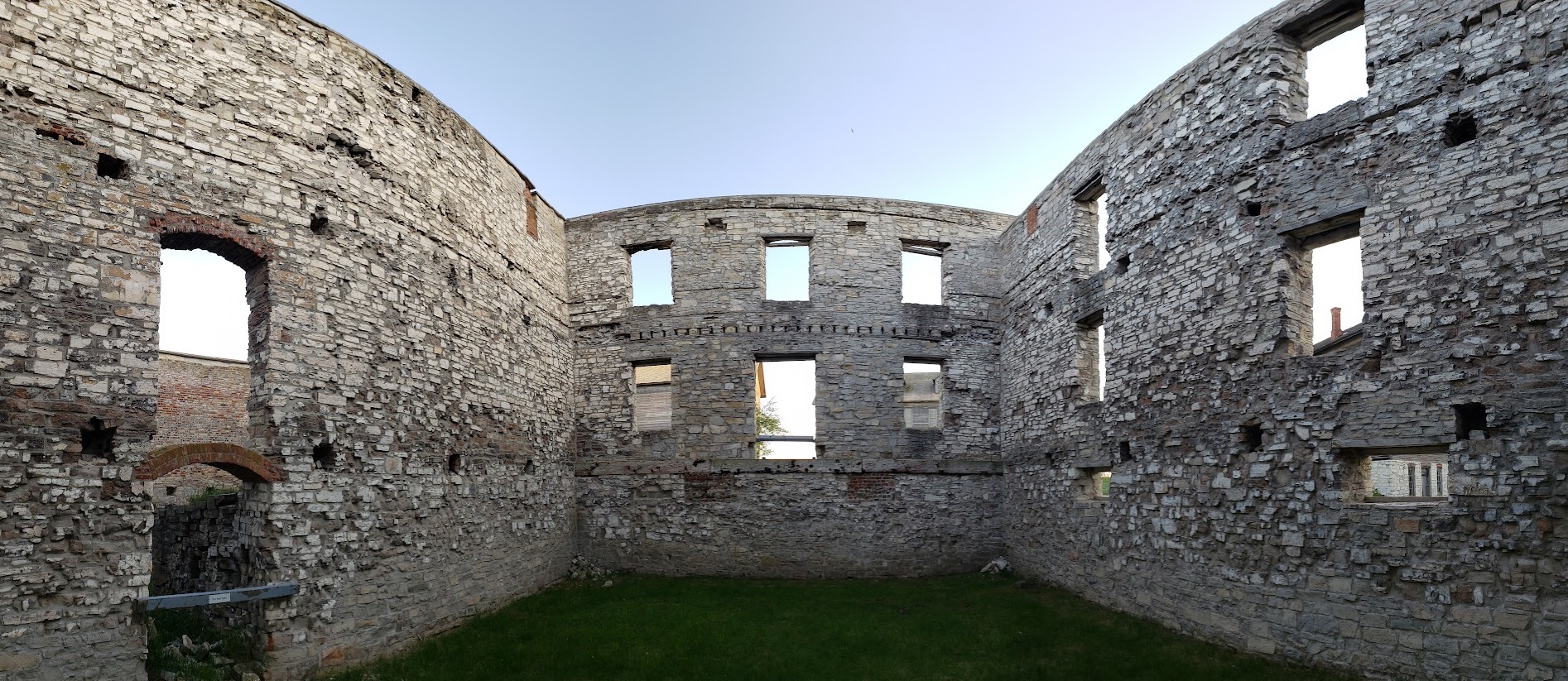
The company store is a proper ruin now. The outer limestone walls are left standing but the roof and all the windows are gone. It looks as though there was once a basement level, a ground level, and an upper level, but all the floors are gone, too. It’s as open and empty as a bombed-out cathedral.
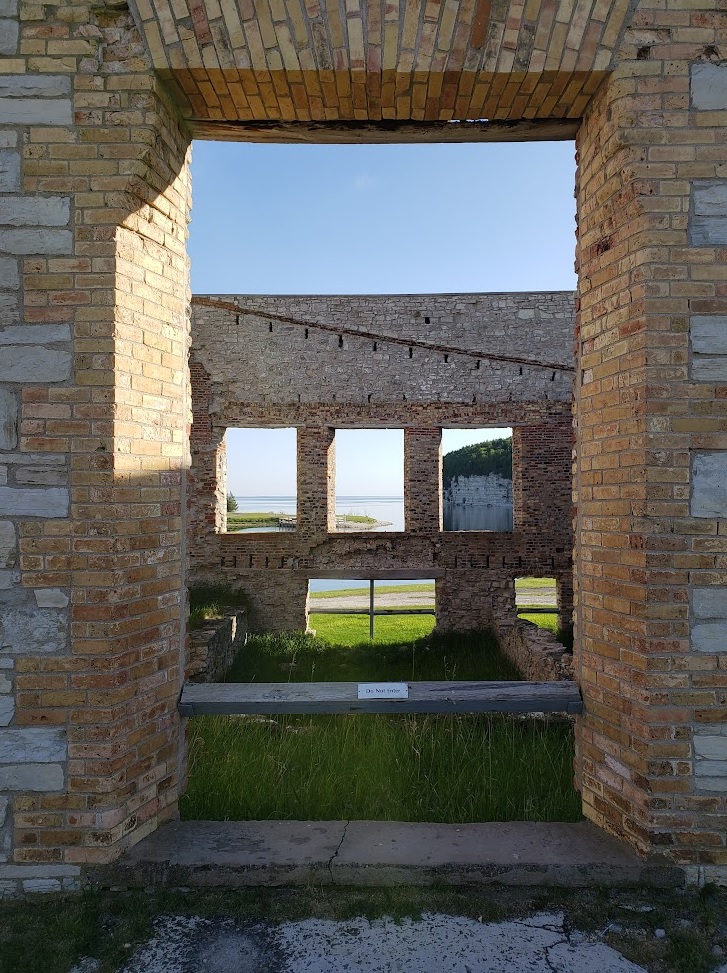
I remember crawling through both sides of the store way back when. The western side is still open but the eastern side is blocked off now and the grass grows high in the basement.

The sign out front of the company store said the residents of Fayette referred to the store as a “pluck me” because of the way their system of purchasing on credit kept people in debt. Hmmm. Do you suppose “pluck” was the word they used? I have to wonder.
By late afternoon I had wandered the streets of the town long enough to give my feet blisters, so I hobbled back to camp and spent the rest of the evening reading in my comfy camp chair with a cold beer close at hand. I may have dozed off a time or two as well, but when it came time for the sunset I made the short walk down to the beach to watch.

Saturday night was a perfectly clear night, which made for a beautiful sunset.

 This Is Drivel
Leave a comment